New March 2026 changes that affect how schools analyze substances
-
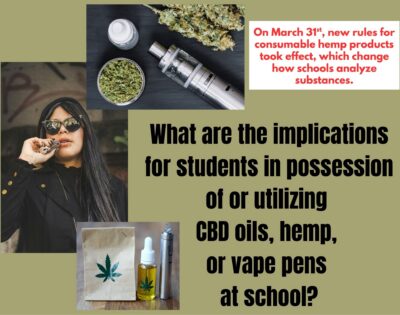
On March 31, 2026, new Texas Department of State Health Services rules for consumable hemp products took effect, changing how THC is calculated in “legal hemp” products sold in Texas.
-
THC content is now measured as “total THC” (delta‑9 THC plus THCA), with a hard cap of 0.3% total THC by dry weight; many high‑THCA hemp and “low‑THC” products that previously tested under the limit now exceed it and are treated as illegal THC products.
-
The same rule set effectively bans most smokable hemp products in Texas retail—hemp flower, pre‑rolls, and other inhalable hemp items—on top of an earlier statewide ban on cannabinoid‑containing vapes (including CBD vapes).
Practical implications for CBD oils, hemp, and vaping in schools
-
CBD or hemp items that exceed 0.3% total THC are now clearly illegal THC products under state health rules; if a student brings or uses them at or near school, they should be treated under your “illegal drug/THC” provisions (DAEP/expulsion) rather than as “legal CBD.”
-
Because smokable and inhalable hemp and all cannabinoid vapes (including CBD) are now banned from retail, any such device in a student’s possession is effectively either an illegal product or contraband, reinforcing DAEP placement under HB 114 for any vape plus potential higher‑level consequences if THC is confirmed.
-
Schools should update handbooks and training language to: (1) clarify that “legal hemp/CBD” must be ≤0.3% total THC, (2) note that smokable hemp and cannabinoid vapes are no longer legal retail products, and (3) continue to apply mandatory DAEP for any vape and for any marijuana/THC offense.
Basic CUP facts nurses should know
-
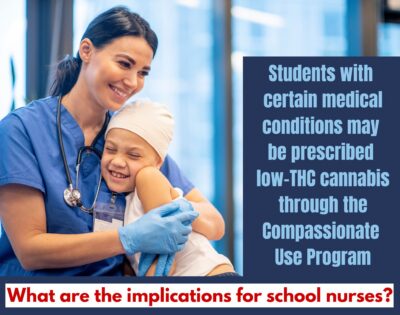
CUP lets specially registered physicians prescribe “low‑THC cannabis” (no more than 10 mg THC per dose) for specific conditions such as epilepsy, autism, cancer, chronic pain, traumatic brain injury, inflammatory bowel disease, terminal illness, and other listed disorders.
-
The program is managed through the Compassionate Use Registry of Texas (CURT), an online system that tracks prescribers and dispensations; law enforcement can access CURT, but schools are not expected to verify prescriptions directly.
School nurse role and limits
-
Standard guidance from Texas school health materials still applies: school nurses may only administer medications that meet district medication policy (proper orders, parent authorization, and storage), and they must follow all nurse practice standards.
-
Because cannabis remains a Schedule I drug under federal law, many districts prohibit storing or administering any marijuana‑derived product on campus, even if prescribed under CUP; in those districts, parents typically must handle dosing off campus or through an agreed procedure (e.g., parent coming to school to administer). Check your district’s board policy.
Practical points for day‑to‑day nursing practice
-
If a parent reports that a student is on a CUP prescription, nurses should: document the condition and medication in the health record, clarify district policy on medical cannabis with administration, and agree on a written plan for when and where doses are given (often off school grounds or by the parent on campus).
-
If a student presents a THC‑labeled oil or product for use at school, nurses should not self‑authorize administration; instead, follow medication policy, notify administration, and coordinate with the parent, because the product may conflict with district policy, federal‑funding requirements, and HB 114 discipline rules if it is treated as marijuana/THC on campus.